Showing posts with label teaching your child to read. Show all posts

Monday, May 6, 2013

Series for Young Readers: Trucktown

My son (age 5 1/2) is sometimes a reluctant reader.  He is always eager to have stories read to him, but he's not always keen to read books on his own.  So, I'm always looking for books that are interesting to him and easy enough that he can read them without help.  If he does engage and read an easy book, it builds his confidence and he's more apt to try it again.


One series he really enjoys is called Jon Scieszka's Trucktown.  The illustrations are funny and full of personality, and the characters are wacky and always in motion.  The text is very simple, but the stories are still interesting.  This is rare to find all of these qualities in an easy reader.  Most boys will really enjoy them.  My three year old daughter also finds them entertaining, probably because some of the vehicles are girls and the pictures are very colorful.

We just finished reading Truckery Rhymes together.  It is a hilarious re-write of common nursery rhymes.  For example, instead of "Pop Goes the Weasel", it says..."Pop! Blows the Diesel".  This book was more complicated than the other Trucktown stories, so I read it to the kids.  I think your family might find it entertaining as well.


Do you have any suggestions of fun books that are great for beginning readers?  Please share your suggestions in the comments.

Friday, April 19, 2013

Our Reading Curriculum for 2012-2013


One of the biggest tasks of homeschooling is choosing what curriculum or learning plan to use.  It is overwhelming to choose as there are so many options available.   Talking to other families who homeschool and doing a lot of research on-line has been invaluable in the decision making process.  Although I've been "homeschooling" our kids from the moment they were adopted, this school year was the first official year for us as our son is now five.  I wanted to share with you what we've done this year for reading. (Keep in mind that he's doing 1st grade reading this year.)  I apologize for how long this is, but hopefully it will be a help to you!  

There are tons of products out there for teaching a step-by-step approach to phonics.  In 2011, I purchased Hooked on Phonics (pre-K thru 2nd grade pack) to teach my son how to read.  It was a season in my life where I was constantly tired with one child who was energetic all day and another (newly adopted) who would not sleep at night.  I had to have a reading curriculum that would require little or no prep from me, and be engaging enough to interest my high octane four year old.  H.O.P. is definitely all of that, and it doesn’t require any handwriting in the early books.  It’s pricey, but a lot cheaper than preschool!  Now that I’m not exhausted all the time, I would not choose Hooked on Phonics as my go-to reading curriculum.  Since we have it, I’m using the preschool activities with our daughter.  However, I rarely use it with our son as we’ve found other books that suit us better.  We do use H.O.P. as a supplemental to get more practice in areas (like consonant blends) that challenge him.  We skip the companion videos completely as they seemed to decrease my son’s ability to focus.

What we really love for learning phonics…Explode the Code workbooks.  Yes, there’s writing, but we modify whenever possible to keep the frustration level down.  These workbooks are simple with silly illustrations and goofy sentences.  They teach phonics in a step-by-step sequence with lots of opportunity for practice, and the kids like them because they’re funny. There is a great three workbook series for pre-readers that I just purchased called Get Ready for the Code.  My daughter (age 3) and I are really enjoying book A, and it’s perfect for her ability level.  My son (age 5 ½ ) is currently working on Explode the Code book 3. We started using Explode the Code when H.O.P. got too challenging (it moves along quickly) for my son, and he began to strongly resist learning to read.  We took a break from the hard stuff and had fun going slowly through the blends in Explode the Code book 2.  Once we got through that book, he was back on track with reading and eager to read out loud with me again.


Rather than go right back to H.O.P. where we’d left off, I decided to start something fresh so we could distance ourselves from the frustration that had caused my son to plateau before Explode the Code.  Thanks to a good friend who homeschools, we decided to try the Pathway Reading Series.  There are 13 books in the series that range from first to eighth grade.   The first book is called First Steps, and is considered a beginning of the year first grade book.  It's hard to find these books, but Exodus Books always has them in stock as so many homeschool families love them.  They are very also very reasonably priced at $6.00 for a hard-bound book, and $2.50 for the workbooks.

Pathway Reading Series begins with First Steps (1st grade) and ends with Our Heritage (8th grade).


We all love this series of books!  My son and I read the stories aloud together and my daughter eagerly listens in.  I love the books because they are similar to what I had when I learned to read back in 1981.  I also chose these books because they teach values through the stories like sharing, obedience, kindness, and being helpful.  The characters are fascinating to my kids, and the stories engage their interest.  The books have simple black and white drawings.  These books were created for the Amish, so there are no pictures of people in them.   I like this because my kids are free to invent their own images of what the characters might look like.  They do enjoy the black and white illustrations of animals and farm life.

There are also workbooks that go along with each book.  The workbooks are very basic in appearance, but that’s fine with me.  I pick and chose which pages to do, focusing on activities that test comprehension, critical thinking, and grammar.  We skip a lot of busy work, and often I will write in the answers as the lines are too tiny for my son’s level of handwriting.  There are auditory tests where he has to circle the word I say, or chose the picture that matches the scenario I read about.  I especially like to do these pages since his answers give me a better understanding of his listening and comprehension skills. 

To round out our reading curriculum, we read aloud twice daily to both of our kids.  We often visit the library to have fresh stories to enjoy together.  I try to get books to engage each of my children individually and some books that they both will like.  We also get books with a CD so they can sit together and listen to a story being read to them.  Most nights, my husband has been reading a novel to the family.  He’s read: The Hobbit, Wind in the Willows, Little House in the Big Woods, Stuart Little, and the entire series about Henry Huggins by Beverly Cleary.  Of course, there was some editing of certain things when it was inappropriate for little ears to hear.  I’ve been impressed with the kids’ ability to listen to a chapter and actually comprehend some or most of it.  They really enjoy this family time and often beg for another chapter.  Love it!

My husband reading The Gruffalo's Child to our two cuties.


A great resource to inspire reading together is a book called First Favorites by Veritas Press.  It recommends 13 different fairly well-known children’s books, some classic and some more modern.  After reading the book aloud, there are activity pages to do together.  It’s writing intensive, which we skipped for reasons already mentioned.  However, it was still fun for us to go beyond the story and do something fun together.  For example, after reading the story Blueberries for Sal, we learned about how bears hibernate.  We colored pictures of bears and then tucked the pictures away in closets so they could hibernate.  When spring arrived, we took our pictures out and celebrated that the bears woke up.  I also bought some blueberries and we made a blueberry pie! 

In a 2012 post, The Next Steps Toward Learning to Read, I mentioned some great books to check out for beginning readers.  These books are very easy so your just learning to read child can delight in reading a story to you. 

Got some great reading books or ideas to share?  Leave me a comment.  I'd love to hear from you.


Saturday, April 13, 2013

A Typical Homeschool Morning


When we started on the adventure of teaching our kids at home, I had no idea what a normal day should look like.  Perhaps you are also wondering how to get started.  Let me share with you some of the details of this morning so you can get a glimpse into our routine. (My son is five and my daughter is three.)

Here are the resources we used for today's lessons.

We started off at 10:00 am with handwriting pages that I’d printed out from Starfall.com.  Yesterday, I noticed that my son was not writing his e’s or u’s properly, so I printed out the worksheets for extra practice.  Some of the pages were too simple for him, so I gave them to my daughter.  She likes to be included, and my son is an extrovert and prefers to have someone else working with him, so they were both happy.  

While my son worked independently, I sat on the floor next to my daughter and we counted eggs on her letter e worksheet.  I helped her write the numbers in the box.  Then we colored eggs that had capital E and lower case e on them.  We also had time to do the letter u page.  Once we finished that, I gave Marisa markers and she colored her pages.

That gave me time to help Kieran think of words that started with E, and write out the word egg.  We focused on staying in the lines and writing as neatly as possible.  I could tell he was getting frustrated after one page of handwriting, so I gave him the option to move on to math.  He was happy to skip the letter u worksheet.  I decided we could tackle that tomorrow.

I gave my son a brief explanation of the two math pages and hopped back to my daughter.  She was done coloring, so we moved on to reading.  I used a flip chart to review the –at words she’s been learning to read. The few words she needed to sound out, my son chimed in and sounded out with her.  (He gets distracted easily, so I had to remind him to move away from us and get his math done.)

These are the activities I did with my daughter today.  

Since Marisa got through the flip chart so easily, I pulled out her Hooked on Phonics preschool book and we hunted for pictures that started with the letter L.  By the end of that page, she was getting antsy to do something else.  I let her choose some stickers for her good work, and then she was off to play.  She plays quietly and independently- which is a huge blessing- so now I was able to give Kieran my undivided attention.

I must add that throughout the time I was helping Marisa, Kieran was interrupting to ask for help, or just to show off his work.  He is a brilliant boy, but often needs reassurance.  He is progressing at being able to finish a whole page, but when we first started kindergarten, he was not able to do three problems on his own.  This may be typical for some kids.  Thankfully, they all mature eventually and get past needing someone to hold their hand all the time.

Back to math…my son is doing Horizons math book 1.  It is actually quite easy for him, but because of his struggle with handwriting we are moving through it at a slower pace.  Today he was enthusiastic about the pages and wanted to do two extra pages.  Great!!  This is the beauty of homeschool.  We go at the pace of each child.  Too hard, slow down.  Too easy, move ahead.  Not working, find something else that does. 

Here is a peek at some of the pages my son did today.

So, we breezed through math and moved on to Explode the Code book 3. I modified the assignment to focus on just the phonics and skip the writing portion.  Asking him to do more handwriting at this point in the day would have pushed us both over the edge! My son did well, but struggled with reading plate vs. plane.  This was a clue to me that he’s not really looking at the whole word, but just enough of it to make a guess.  I made a note in his book to practice more words like these next time.  

After Explode the Code, we moved on to our final assignment: short and long vowel words.  I have a list of 18 short vowel words on a page. I put a plastic cover over the sheet so we can write on it with a Vis a Vis marker, erase, and use it again later.  I had him read the word can, then I wrote an e behind it to make cane.  When we got to man/mane it prompted an interesting discussion on the definitions of mane, Maine, and main.  Once we were done, I made a quick note of the words that were difficult for Kieran so we can practice those next time. 

I got this idea from working at Sylvan.  It's a great way to help your child practice the silent e rule.

By 11:00 my son’s attention span was spent.  He was eager to run to the window and watch his daddy mow the lawn.  While the kids watched my husband, I made brief notes on my iPad for our next class based on the progress and struggles we had today.  It took me about five minutes to complete.

That’s a fairly typical homeschool day.  Although the official learning time has ended, we are never really done teaching.  All day we will have teachable moments where we are imparting something to them.  But that’s a post for another day. 

Next time I will post more specifics on the books we are using this year as choosing curriculum can be one of the most daunting parts of jumping into homeschool.  

Thursday, January 26, 2012

Want to Read Along?

Hi friends, how about a virtual book club?  I love to read, and have three books that I'm enjoying right now.  If you are interested, you can read along with me....

Choosing to SEE by Mary Beth Chapman


Wow, this is a good book.  I've already read 169 pages in two days!  Some parts are tough- really tough to read- other parts have had me laughing out loud.  Mary Beth is the mom of six children, so all moms will relate to some part of her story.  She's adopted three daughters from China.  (We adopted our daughter from China a year ago, so I've greatly enjoyed the stories about China.)  Mary Beth also shares candidly about her struggles with depression, self-image, and dealing with grief and the loss of her youngest daughter.  She is married to the well known Christian musician Steven Curtis Chapman and shares interesting stories about their life together.  This book is ultimately a message of hope and points the reader to God who holds the whole world, and each of our stories, in His hands.  I think you'll enjoy it.

The Read-Aloud Handbook by Jim Trelease


I originally purchased this book for the recommended reading book lists in the back.  Once I cracked the book open though, I got sucked into all the interesting facts and findings about what causes some students to succeed and others to fail.  (Surprise!  The common denominator for successful students is that they were read to on a regular basis.  Thus, the reason for the book.)  Mr. Trelease gives lots of facts, details, and anecdotes to prove his point.  It's not a dry book at all as he shares personal tidbits often to keep it real.  He also gives some great recommendations of how to read to your kids at each age level.   But, he is so passionate about his subject that sometimes I feel like he being alarmist, or ranting a bit.  I don't agree with his feelings that the government should shame and bully parents into reading to their kids.  To me, that's extreme and not the way to go about things.  I have only read two of the nine chapters in this book, so I'm not sure if my opinion on the author's tone will change or stay the same.  All in all, I've already learned a lot from this book, and I've found the research and study results fascinating.  This is probably because I'm a teacher and helping kids learn- especially learn to READ- is one of my passions.  This book will not appeal to all moms, but it's worth checking out at the library to get some good read aloud suggestions.  The books are organized according to age groups so it's easy to find a section that would be applicable to your children. 


This is a devotional study on the names of God.  I am really excited to embark on the journey of getting to know God better.  A friend of mine recommended this book to me, and already after one day into it (I'm on page eleven)...I'm recommending it to you!  I've always loved mysteries and as a girl I spent my summers reading Nancy Drew books.  So, I'm realizing that I'm excited about this book partly because God is a mystery to me in many ways.  I want to know Him better.  Each section of this book is peeling away a bit of the mystery and revealing more of the truth about our Maker.  Another reason why I bought this book is because being a mom has showed me on a whole new level how much I need God's help.  He has all the answers, and I definitely don't!  Also, I want my kids to know God and find comfort and hope in Him too.  The better I know Him, the better I can parent them and teach them about their Heavenly Father.  Finally, this book is very encouraging.  It's full of truth and life because it's filled with scripture.  This book is like eating cheesecake- I take a bite and then savor it.  I read a bit and then mull it over and ponder the truth for a while.  Soon I find myself hungry for more and jump back in for another bite.  Oh, it's so good...life to my soul!  Why not join me in this Bible study?  


Wednesday, January 11, 2012

The Next Steps Towards Learning to Read

So, your child knows the ABCs and the sounds that they all make.  Now what?  Start putting together three letters words with a short vowel in the middle.  The curriculum I used with my son focuses on one ending sound per lesson.  I've listed them below so you can see the progression and use it if you want to.  Overall, the strategy is a simple one and it works because it's phonics based.

Lesson 1: -at (bat, cat, mat, sat, etc...)
Lesson 2: -an
Lesson 3: -ap
Lesson 4: -ad
Lesson 5: -am
Lesson 6: -ag
Lesson 7: -ab
Lesson 8: -ig
Lesson 9: -id
Lesson 10: -it
Lesson 11: -ip
Lesson 12: -im
Lesson 13: -in
Lesson 14: -ix
Lesson 15: -ill
Lesson 16: Add -s to the end of words

In my post Reading Readiness Part 2: Phonics, I shared a bunch of activities that you can do to practice the various endings I've listed above.  Also, if you want a good book that will guide you in teaching your child how to read, check out The Ordinary Parent's Guide to Teaching Reading at your local library.  I am not using that book, but have read through it.  It doesn't have fancy graphics, but will give practical guidance.  I chose not to use it because I wanted a workbook driven program that would have glossy pages, nice illustrations, and little to no prep work for me.  (I am definitely a visual learner!)

In our reading program, Hooked on Phonics, there are also sight words that are introduced along the way. They are simple words that show up often in daily reading, so it's a good idea to have your child memorize them.  Some of the sight words can be sounded out with the phonics rules, but others don't play by the rules and it's just easier to memorize them.  (For example, the word "THE" is impossible to sound out.)  You can introduce the sight words two at a time, or three at most.  The goal is to not overwhelm the child with things to memorize since we want them to focus on sounding out words.  I made flashcards for each word and we reviewed them during meal times.

Here are the beginning level sight words:
he
a
the
no
and
has
is
on
she
what
this
they
go
have
do
look


Now I'm Reading! Series
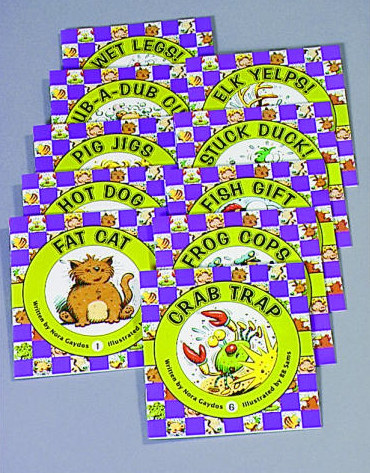
Finally, kids love to be able to use their new reading skills to read a real book.  It's hard to find something they can read immediately after they learn "at" words, but I have a few suggestions for you.  Check out from your local library the Bob Books.  These books are very basic, the illustrations are underwhelming, but the text is perfect for the beginning reader.  My son was not inspired by them, but maybe your child will be.  We had more success with Pig WigWet PetStop Pop, and Quack Shack by Yukiko Kido.  (Warning: Crab Cab has some gross words and pictures ie: snot pot-- so you might want to avoid that book in the series.) The books have eye-catching illustrations, some cut-outs, and one or two words per page.  We really like them and have checked them out several times from the library; I'm thinking of purchasing a few.  The other series that I would highly recommend is called Now I'm Reading! for Beginning Readers by Nora Gaydos, illustrated by BB Sams.  We own the 20 book set called Animal Pals, but I can not find it on Amazon.  They seem to have split it up into two 10 book sets.  Anyway, the books all contain simple short vowel words, with vivid and silly illustrations.  The books start out easy and slowly become more complex as you progress through the series.  The only drawback is that they are more wordy than the other books I've mentioned.  One tactic that works for books like these is to share the reading and you read page one, your child reads page two.  That way you can get through the whole book without your child feeling overwhelmed.
Pig Wig by Yukiko Kido: Perfect for readers who are just beginning to learn how to read.

If you have found some good beginning reader books, please share the titles in the comments.  I am always looking for books for K to read.  Also, you can have your child help you make up stories using the words he or she knows how to read.  We haven't tried that yet, but it sounds like fun.  Sometime in the future I'll share more about our reading program with the next level of word endings and sight words. Until then, let me know how your little readers are doing.  :)

My little reader.  He's pretending to read this book:
Diamond in the Snow by Jonathan Emmett

My pre-reader.  She loves to look at books
and listen while we read to her.
 

Sunday, January 1, 2012

Teaching the Alphabet to Miss M

Last year I shared some reading readiness tips that I used with my son when he was two.  Now my daughter is a month away from turning two, and she's also on a journey toward learning to read.  Sadly, I have less time to devote to teaching her, but she's still progressing nicely and knows more than 50% of the alphabet.  Here are some of the tools I've used with her that I didn't have when her big brother was two:

·      Our new favorite book: Learn with Humphrey ABC by Sally Hunter.  It's from the UK, but I'm hopeful that you all will be able to find it locally.  The illustrations are just adorable!


·      LeapFrog magnetic alphabet for the fridge (I like these because they are too big for kids to swallow!) I picked up two sets at garage sales last summer for about a dollar or two each.  They came with an attachment that says the name of the letter and it's sound, but it's annoying.  I put that part up and we just enjoy the letters.  
Here are a few suggestions of ways you can use the letters to help you teach your child:
  •  You can display several letters at a time to introduce them rather than overwhelm with all 26.
  • Or just have up the letters that they haven’t learned yet. We did this for a while and I encouraged big brother to teach his little sister the letters whenever they were hanging out in the kitchen.  Not sure how effective it was, but they had fun.
  • Use the letter to attach something to the fridge that starts with that letter.  Right now we have Christmas photos with the letter that corresponds to the family’s last name holding the photo in place.   (That's more of an activity for big brother, but both kids get something out of it.)

·      Melissa & Doug train alphabet puzzle- very cool; it’s 10 feet long!  
·      Foam letters in the bathtub- they stick nicely to the tub sides, but do clutter up the bathroom.
·      LeapFrog laptop.  I'm sorry to say that my daughter learned most of her letters from this.  You can personalize it so the laptop will say the child’s name, sing a song with your child’s name in it, and include brief emails from family members.  (My son also has one, but at age 4 he gets bored with it faster than she does.)  It's perfect for teaching letter names and their sounds.  I got one for each of our kids as a way to keep them busy at the rehearsal for my sister's wedding.  It's a nice item to pull out when I need them to stay busy, but it is a noise making toy so I don't leave it out all of the time.
It also comes  in green and white for boys.


Besides the gadgets, books, etc...we are also singing the ABC song at various times through out the day, and taking the time to point out letters where we see them.  I was impressed a couple of months back when my daughter noticed the contrails of two jets in the sky.  She shouted out, "X!" and pointed up.  Sure enough, there was a perfect X.  My kids are often reminding me that kids are smarter than we think they are!

For my next post, I will share a road map of the kindergarten reading program I used with my son.  It' works!!  Forgive me if it takes a while to get it posted, but I promise to share the strategies so you can use them too.  

Tuesday, October 18, 2011

Preschool or Homeschool...It's No Longer A Question

Our son turned four recently!  He's learning to read with Hooked on Phonics.
Last year I started teaching my son how to read.  Then we got our referral from China and all formal homeschooling came to a screeching halt as we adjusted to life with a new baby girl.  Almost a year went by (time does fly!) while I debated about what was the best path to take for K's education.  I was contemplating preschool mostly as a way to give him a "social life" and me a break with his little sis for a couple of hours.  Fall was nearing, and K's 4th birthday, so I knew it was time to make some decisions.  My husband was not in favor of sending our son to preschool.  He had a lot of good reasons.  My reasons for opting for preschool I mentioned above.  I looked into a church preschool near our home that had been highly recommended thinking maybe I could persuade my husband to change his mind.  Once I saw the curriculum and the cost it was obvious that preschool was not the right choice for our son.  They charged $120 per month, for four hours of instruction per week, to teach the kids the alphabet and the sounds they make.  Plus some counting, shapes and colors, etc... would be included.  I couldn't justify sending our son off to a school that would teach him what he already knows. That seemed silly to me and a real waste of money.  I looked at Hooked on Phonics and found out with an on-line coupon, it was only $140 for the entire package which includes preschool-2nd grade books, workbooks, dvd, and parent guides!  I'd pay almost that much in one month for him to learn four letters of the alphabet at the local preschool!!  So, I ordered Hooked on Phonics that very day.  We have been working through the program for about a month now. We love it! The preschool level was too easy (I'll use it for little sis eventually), so we jumped in at the kindergarten level.  K & I are both enjoying it a lot.  We do our homeschool lesson while little sis naps.  It has become a special bonding time.  Besides learning to read, he also does one activity sheet (from the H. on P. preschool extras worksheets) of his choosing.  Usually it involves cutting and pasting, which are new skills for him.  He's also practicing drawing and writing letters as well.  I know there are probably tons of programs that teach children to read successfully.  I was too tired to try and research a bunch, so I went with what I'd heard about.  It is working, and K is reading the little books with simple words that they provide as well as some books that I have or have checked out from the library.  What I like best about it is that it's sequential and organized.  It gives me a starting point to work from, and then I can get creative and add to it to fit what my son needs.  For example, he was struggling with certain words and ending sounds.  So I used a variety of methods (flip chart, letter cubes, magna doodle, home made worksheet...) to just review those words until he got them fluently.  Then we moved on with the H. on P. program.  I hope to share more about teaching K to read at home.  For now, I just wanted to share an update and give a plug for homeschooling.  It rocks! I'm so glad that I made the choice I did, and I have to admit that my husband was right about preschool.  It's sad that I took so long to agree with him on it.

Wednesday, May 4, 2011

Product Review: Scribble & Write

I have ideas all the time that I'd like to post about, but so little time to actually sit down and blog about them.  Since I have a few moments, I'll share a quick thought...for Christmas we got our son a LeapFrog Scribble and Write.  It has been a really cool toy.  He's learning how to write letters, draw shapes, and follow directions.  It also reinforces the sounds the letters make so it's sort of a learning to read tool also. I tend to put it out of reach and then pull it out when I need K to keep himself busy for a bit.  He's always glad to play with it.  We recently went on a car trip and the Scribble & Write kept him entertained for a long time.  Then his sister got a hold of it and doodled all over it for a long time.  She's only 14 months, but likes to do whatever big brother is doing.  Anyway, wanted to share with all my mom friends that this is definitely a toy worth buying, and runs just under $20 at Wal-mart or on Amazon.


Tuesday, November 2, 2010

Reading Readiness pt 2: Phonics

Once K had learned the alphabet, it was time to teach him the sounds that the letters make.  I wish that I could say I used all kinds of clever hand made games and crafts to teach the sounds.  However, the truth is he learned it from a video!  My friend, Kelly, told me about The Letter Factory DVD by Leap Frog Learning.  It is engaging, clever, and teaches phonics in a fun way.  Plus, at $8.99 on Amazon, you really are getting a great deal!  (The tutoring company I work for charges a lot more than that per hour!!)  In about two months, our son knew all the sounds.  The vowels seem to be the hardest for kids, especially differentiating between short vowel "e" and short vowel "i" sounds.  I still mix them up myself, like when I say ten it often comes out as tin.  A quick review for those who may have forgotten what short vowels are: apple, elephant, igloo, octopus, and umbrella are the short vowel sounds.  The long vowels sounds are the actual names for the vowels like: ape, eagle, ice, over, and use.  We'll tackle long vowels later.  For now, K is only aware of the short vowel sounds.

I also got him Talking Words Factory as a follow up DVD to The Letter Factory.  The sequel teaches how to put the sounds together to make words.  Talking Word Factory does a great job of teaching the concept of how words are built.  It focuses on the basic consonant, short vowel, consonant (CVC) words like CAT or FUN which is perfect for beginning readers.  They do introduce blends, but it is a brief part of the video.  With K, we are only working on the CVC words at the moment until he really gets comfortable with sounding out these basic words.  We have been doing all kinds of fun activities to help him learn how to read.  I took pictures of some of our "home school" assignments so you all can see what we've been doing, and maybe inspire some of you to give it a try.

I created a simple worksheet on the computer leaving blanks  (like ___ ot) for  K to stamp a letter.  All of the words in the first column end in "ot".  The second column is all "et" words.  Rather than giving him the entire alphabet stamp set, I only set out letters for him to use that would create real words.  Once he's more proficient, he can figure out which letters make real words and which ones don't.  For now, he has fun discovering what new word he's just spelled.

We practice his new words whenever he's in the mood.  Since it's at his height,  he sees them often and enjoys going through the list of words.  At first, I folded the sheet in half and we covered up all the words except one.  That way he wasn't overwhelmed by a whole sheet of new words to tackle at once.  (This worksheet has "at" and "an" words.)

Practicing our "at" words.  Notice I gave him a selection of letters at the bottom that will all make real words when paired with "at".  We sometimes do this activity while he's eating a snack or lunch.  Other times, K will just pick up the letters on his own and start making words to proudly show off to whomever is near by.  I'm finding letters all over the house!

Since K just turned three, he's not able to write letters yet.  He was constantly hounding us to write out words for him.  We got him a Magna Doodle for his birthday and I had an "ah ha!" moment, "We can use the magnetic letters and he can create words on his own!"  Sometimes we'll write words on his Magna Doodle for him and he can read them to us.  This is a fun activity to do in the car, or at a public place where you have to sit and wait quietly, like a restaurant.


Here's a great beginning reader book.  The pictures are fun, and the words are all CVC so they are perfect for our little reader.  We've practiced and practiced the words in this book.  He wasn't able to just breeze through it the first time.  There are three sections in the book, we usually get through only one section and he's done reading for a while.  

Same series, obviously.  I was so pleased to find these two books at the library.  It's very rewarding for new readers to have a book that is at their level.  It's very exciting for them to open a book and be able to read every word in it.  With K, we go slow, encourage a lot, give some hints with sounding out, and keep it fun.  If it's too hard or not enjoyable, we stop and come back to it later.  
One more observation...When we go out, K's always aware of letters and words that show up on signs or wherever.  He's eager to point out words he knows.  Sometimes he'll see a word he knows as part of a larger word for example, "material".  He'll say, "Look, that spells MAT!".  I'm always quick to praise him and then show him that the whole word says material.  My son is teaching me that kids are much more alert than I thought!

In the future, I'll share more as we progress in our journey of teaching K to read.  Thanks for visiting my blog!

Tuesday, October 26, 2010

Author Spotlight: Sandra Boynton


One of the first books given to our son was Snuggle Puppy by Sandra Boynton.  That was our introduction to a wonderful and quirky author that has become a family favorite.  Young toddlers can connect with Boynton's funny characters, simple rhyming text, and colorful illustrations.  Adults will appreciate the humor.  The amazing Ms. Boynton- author, illustrator, and composer- writes songs to accompany some of her books.  The songs are incredibly goofy and fun; we love "Barnyard Dance".  You can download several of her songs for free at: http://www.workman.com/boynton/.  "Personal Penguin" is one of my favorites; give it a listen.  We own seven Sandra Boynton books including: Snuggle Puppy; Barnyard Dance; Belly Button Book; Fifteen Animals; Hey! Wake Up! Blue Hat, Green Hat; and Oh My Oh My Oh Dinosaurs.  Plus we've checked out many others from the library.  It's hard to choose a favorite, so I won't try.  These board books are a perfect way to share the joy of reading with a young child who has a short attention span.  Besides being entertaining, Boynton's books are also educational as they introduce: counting, colors, opposites, animal sounds, and much more.  It's sad, but our son who is three now, has sort of outgrown these books.  I'm looking forward to revisiting them with our daughter once we bring her home from China in a couple of months.

Sunday, October 24, 2010

Reading Readiness

I have been an educator for 12 years now.  I started out teaching full time in an elementary school, and then seven years ago I switched to tutoring for a well known tutoring agency.  (No need to give them free advertising :)  I love teaching, especially helping kids learn to read.  Of course, being a teacher, my son gets taught at home whether he wants to be or not!  Thankfully, he's three and wants to learn about everything.  He began to show an interest in learning to read when he was two.  He picked up the alphabet thanks to Dr. Seuss's ABC and began asking what letter words start with.  That was a huge sign to me that he was ready to learn phonics.  Now he is starting to sound out some words on his own and it's so much fun to watch it happen! I wanted to share with my fellow moms what I've learned so far. 


It's really not hard to teach a child to read.  When they are young, interested, love repetition, have no concept of things being "too hard", and motivated to achieve new things...that's the perfect time to introduce phonics.  As long as it's fun, and there's no pressure, I believe in giving them the opportunity to learn how to read.  I don't believe that there is specific age that constitutes ready to learn.  I think it's more according to their interest.  If you are sharing the joy of reading with them on a daily basis, they will most likely want to learn to read.  

Some suggestions for teaching your child to read:

1. Start by reading to him or her every day. We read before nap and bedtime, as well as random times throughout the day.  We visit the library often.

2. Include in your reading some books that teach the alphabet. (There were over 6000 suggestions when I searched on Amazon!) Here are a few I like:

· Dr. Suess’s ABC (My son learned his alphabet from this book!)

· Chicka Chicka Boom Boom

· A to Z by Sandra Boynton

· Richard Scarry’s Cars & Trucks from A to Z

· Curious George's ABCs

3. Sing the ABCs during the day: diaper changing, brushing teeth, in the car… I like to chose a singing style: opera, country, jazz, whatever.  It’s fun for everybody!

4. There is a multitude of toys that incorporate the alphabet to heighten awareness. Some that we own are: wooden ABC puzzles, an alphabet placemat, stacking blocks with letters, and magnetic letters with a wipe-off/ chalkboard. We’ve also created letters with play dough, so you can use what you have to make letters too. My son even started making letters on his own with string or a strip of paper, and sometimes his food!

5. Purchase some magnetic letters for the fridge and make easy words together like "cat" or "dog", and spell out names of people in your family. That way your child sees that letters work together to make words. Plus they're learning that we read from left to right.

6. Flashcards are a great way to quiz your child and see which letters they know. Make sure to get (or make) cards that include lower case letters separately. You can play a matching game to find the capital and the lower case letters that go together.

7. Your child will probably be pointing out letters everywhere you go by now. Have fun with it and start talking about beginning letters of words, like: “Costco starts with C!” We have an on-going game to see how many words we can think of that start with a particular letter. Names of people are favorites with my son.

8.  Read text to your kids wherever it pops up, like brand names on their clothes.  They will begin to recognize the font or logo and feel proud that they can "read" the words.  (Like: Gymboree or OshKosh)

There are lots of other possible ways to introduce and teach the alphabet, so please share in the comments other ideas and suggestions.  As a teacher, I'm always looking for new and fun methods to use with my students.   In a future post, to follow soon, I'll share how we taught phonics to K and the simple steps to take from there so your child can begin to sound out easy words.